
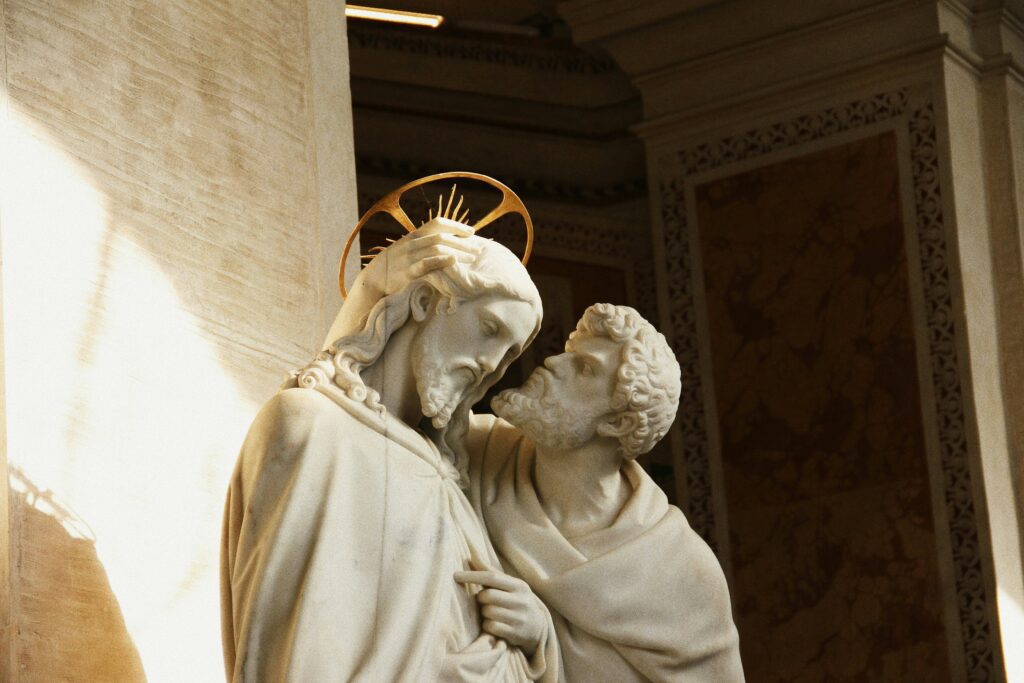
For this year’s Palm Sunday article, I’m looking at one of the true tragedies of the coming week: Judas. Of all the people involved in the chaotic (from the human perspective) and carefully-planned (from God’s perspective) events of Holy Week, Judas was the one who didn’t make it through to the end. What went wrong?
The Bargain
Judas would have been there all during Jesus’ ministry. He would have seen the feeding of thousands, the walking on water, the calming of the sea, the healing of the lame, the blind, and the deaf. He would even have been there the week before as Jesus raised Lazarus from the dead. But even after all of that…
Just a day or two before their last Passover meal — after the Triumphal Entry, the cleansing of the Temple, sparring with the Pharisees, parables contrasting the faithful with the faithless, and a woman using expensive perfume to anoint Jesus for His burial — Judas went to the chief priests and offered to hand Jesus over to them. The priests needed his help to get access to Jesus at a time when He was not surrounded by crowds who would be outraged at His arrest. They were willing to pay thirty pieces of silver for that help. Judas accepted the deal. (Matthew 26:14-16)
Note that the 30 pieces of silver fulfills Zechariah 11:12-13;. It also happens to be the price that would compensate for a slave (Exodus 21:32), making it an insultingly low amount for the incarnate Son of God! The betrayal itself fulfilled Psalm 41:9.
The Breaking Point
During His last supper with the disciples, John tells us that Jesus began by doing the unthinkable: He traded His regular clothes for those of a servant, and washed their feet, one of the lowliest tasks imaginable. What a concept: Jesus knelt and washed the feet of the man He knew was about to betray Him! (John 13:1-11)
After changing back to His normal clothing, Luke tells us that Jesus broke some bread, gave it to them, and said “This is My body which is given for you“. He followed this by taking wine and saying “This cup which is poured out for you is the new covenant in My blood.” (Luke 22:14-20)
It was then that Jesus predicted one of them would betray Him: “But behold, the hand of the one betraying Me is with Mine on the table. For indeed, the Son of Man is going as it has been determined; but woe to that man by whom He is betrayed!” Of the twelve, eleven were truly horrified at the thought that they might do such a thing: “Being deeply grieved, they each one began to say to Him, ‘Surely not I, Lord?’” (Matthew 26:20-25)
Judas joined the chorus, “Surely it is not I, Rabbi?“, to which Jesus responded “What you do, do quickly.” Judas left the dinner immediately, leaving the others to wonder where he was going. Maybe to buy something needed for the meal, or maybe to give something to the poor? Jesus knew better. (John 13:21-30)
The Loss
Judas had stayed long enough to have his Master wash his feet like a common servant, predict that His body would be broken, and say that His blood would inaugurate a new covenant to replace the one begun with Moses at Mt. Sinai centuries before. But he left before he could hear Jesus say that “Now is the Son of Man glorified“, “I go to prepare a place for you“, “I am the way, and the truth, and the life“, “He who has seen Me has seen the Father“. (John 14:1-14)
Judas didn’t hear the promise of the coming Holy Spirit. He didn’t hear “Peace I leave with you; My peace I give to you; not as the world gives do I give to you. Do not let your heart be troubled, nor let it be fearful.” (John 14:27) He didn’t hear Jesus foretell His resurrection: “You will grieve, but your grief will be turned into joy…I will see you again, and your heart will rejoice, and no one will take your joy away from you.” (John 16:16-22) He didn’t hear “In the world you have tribulation, but take courage; I have overcome the world.” (John 16:33) He wasn’t included in the beautiful High Priestly Prayer of John 17. What magnificent comforting promises Judas didn’t hear!
Heedless of what he was missing, Judas followed through on his agreement with the priests. He earned his thirty pieces of silver. He betrayed the Rabbi he had followed for years. He saw that Rabbi arrested by an armed mob. And he saw the result:
While He was still speaking, behold, Judas, one of the twelve, came up accompanied by a large crowd with swords and clubs, who came from the chief priests and elders of the people. Now he who was betraying Him gave them a sign, saying, “Whomever I kiss, He is the one; seize Him.” Immediately Judas went to Jesus and said, “Hail, Rabbi!” and kissed Him. And Jesus said to him, “Friend, do what you have come for.” Then they came and laid hands on Jesus and seized Him.
Matthew 26:47-50, Matthew 27:1-2
…
Now when morning came, all the chief priests and the elders of the people conferred together against Jesus to put Him to death; and they bound Him, and led Him away and delivered Him to Pilate the governor.
The Aftermath
Then when Judas, who had betrayed Him, saw that He had been condemned, he felt remorse and returned the thirty pieces of silver to the chief priests and elders, saying, “I have sinned by betraying innocent blood.” But they said, “What is that to us? See to that yourself!” And he threw the pieces of silver into the temple sanctuary and departed; and he went away and hanged himself.
Matthew 27:3-5 1
Note that Judas had his change of heart not at the arrest, nor at the crucifixion. It was in between, when he “saw that he had been condemned“. Why at that moment? A possibility is that he didn’t expect any punishment to go that far. Maybe he was willing to betray Jesus to arrest, maybe to imprisonment…but not to death. The Bible doesn’t tell us what Judas was thinking; it only tells his actions.
The Motive
Was Judas really so diabolical that he could infiltrate the group, play along for years without getting caught, and meticulously plan to destroy Jesus…only to regret it when his mission succeeded? That doesn’t seem realistic. Did he follow Jesus honestly, only to be overcome by greed? Maybe, but that seems like a stretch. Thirty pieces of silver is a lot, but not that much: Thirty silver coins were probably equivalent to 120 denarii, or about four months wages 2. Luke and John tell us that Satan “entered Judas” and “put into his heart” to betray Jesus. What could have made Judas susceptible to that?
Again, the Bible doesn’t tell us what was in Judas’ mind. But a common interpretation of his motive is that he was trying to force Jesus’ hand. If he was sure that Jesus was the Messiah, then he was also sure that the Messiah would of course not let Himself be defeated. Was he waiting eagerly for Jesus to call down lightning bolts on His persecutors and charge out of Gethsemane as a conquering King? Did the remorse come only after he realized that his dream was not going to happen, that Jesus was going to die? Was the guilt because he thought he had mistakenly doomed an innocent man, a plain human being who wasn’t the Messiah after all?
Judas felt guilt and remorse, but didn’t turn to God with those feelings. Jesus was condemned and under heavy guard, so Judas couldn’t have gone to Him in repentance. Where could he turn? As far as he could see, nowhere. He saw no hope of redemption; he saw only despair.
Could it have been otherwise?
The Alternatives
If Judas had waited three more days, he would learned of the resurrection. He would have found that Jesus was far more Messiah than he could ever have imagined. He would have known that nothing, not even his betrayal, was able to thwart God’s plan. In fact, that betrayal was part of the plan, known and intended all along!
What would that have meant to him? There’s no getting around the fact that what he did was still despicable. But what if he had encountered the risen Jesus? I see two main possibilities.
The first, and saddest, possibility is that Judas could have still turned his back on Jesus. He could have let his guilt and remorse block him from being willing to accept forgiveness even if it was offered. He could have been angry at Jesus for not somehow stopping him from being such a fool. He could have still wanted a military Messiah, and continued to wait for Jesus to do the “right” thing. He could have disbelieved the overwhelming evidence, continued to act on pre-resurrection information, and still chosen to end his life as nothing more than a traitor.
…or…
The second possibility, the one I wish had happened, is that he could have gone to Jesus with a broken heart, begging for forgiveness. I know what the response would have been: love. The Son of God, come into the world to seek and to save the lost, would have joyfully welcomed his lost lamb back into the fold.
The Tragedy
No one is too sinful for Christ’s redemption, not even Judas. If only he had waited to learn that fact!
If only……..
For of all sad words of tongue or pen, The saddest are these: ‘It might have been!’
John Greenleaf Whittier, 1856 poem “Maud Muller“
Footnotes and Scripture References
- Note: In Acts 1:15-19, when Peter was advising that Judas’ role as one of the Twelve be re-filled, he described him like this: “Brethren, the Scripture had to be fulfilled, which the Holy Spirit foretold by the mouth of David concerning Judas, who became a guide to those who arrested Jesus. For he was counted among us and received his share in this ministry.” (Now this man acquired a field with the price of his wickedness, and falling headlong, he burst open in the middle and all his intestines gushed out. And it became known to all who were living in Jerusalem; so that in their own language that field was called Hakeldama, that is, Field of Blood.)”
The most common explanation for “hanged himself” vs “acquired a field and falling headlong, burst open” is that hanging came first, then later the decomposing body fell and burst. In Matthew, the priests bought the field using the money Judas returned; Acts compresses the middleman as if Judas had made the purchase himself. - https://byustudies.byu.edu/article/coins-in-the-new-testament https://www.julianspriggs.co.uk/pages/Money