
The U.S. abounds with temples, churches, synagogues, mosques and other place of worship. An AI search found over well over 350,000 of them. Most are Christian churches, but there are also 3000-4000 each of mosques and synagogues, 2000-3000 each of Buddhist and Hindu temples and a few thousand worship centers of other faiths. To the Jews of the Bible, though, there was only one capital-T Temple: the one in Jerusalem. I’d like to look at its history, and what made it so special.
That Temple went through three major iterations: the original Tabernacle tent, the magnificent structure built by King Solomon, and the replacement structure built after the return from exile in Babylon. Each was significant as the home of God’s most visible presence among His people.
The Tabernacle

At Mt. Sinai about three months into the Exodus journey from slavery in Egypt, the ancient Israelites agreed to become a nation of God’s chosen people (Exodus 19:1-8). God then spelled out the terms of that agreement, including the Ten Commandments. He also gave the design specification for the Tabernacle, a portable tent where He would meet with them. You can read a more thorough description of this tent in this article, so I won’t repeat much here. The main point to take away is that the Tabernacle was the focal point that housed God’s manifest presence among His people.
Then the cloud covered the tent of meeting, and the glory of the LORD filled the tabernacle. Moses was not able to enter the tent of meeting because the cloud had settled on it, and the glory of the LORD filled the tabernacle. Throughout all their journeys whenever the cloud was taken up from over the tabernacle, the sons of Israel would set out; but if the cloud was not taken up, then they did not set out until the day when it was taken up. For throughout all their journeys, the cloud of the LORD was on the tabernacle by day, and there was fire in it by night, in the sight of all the house of Israel.
Exodus 40:34-38
Solomon’s Temple
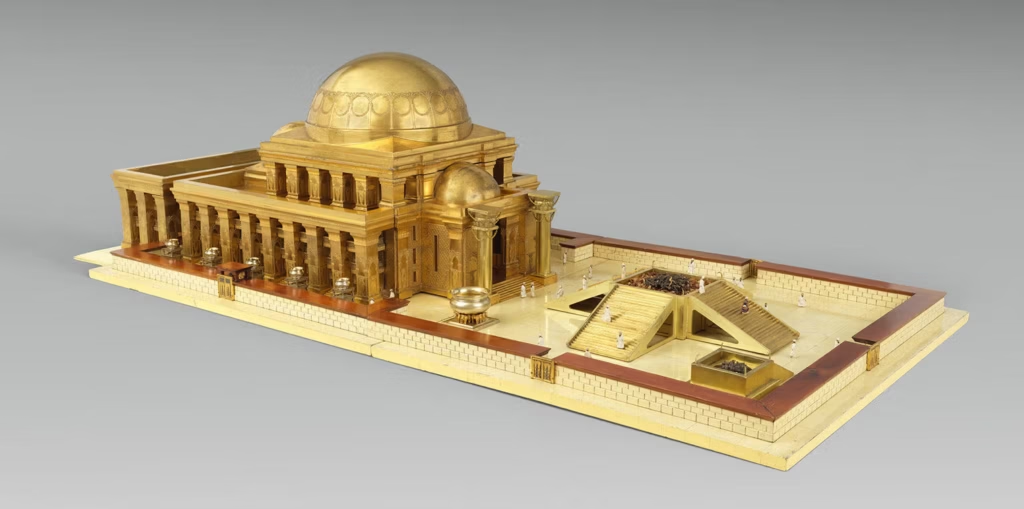
About 500 years later, King David wanted to build a better showplace for God, a temple instead of a tent. God accepted David’s offer of praise, but told him that the temple would be built by his son rather than him (2 Samuel 7:1-16). David’s son Solomon spent seven years building an extraordinary structure, using the same general-to-most-holy layout as the Tabernacle but on a grand scale (1 Kings 6). At its dedication, when the priests formally moved the Ark of the Covenant to its new home, God’s glory went with it:
It happened that when the priests came from the holy place, the cloud filled the house of the LORD, so that the priests could not stand to minister because of the cloud, for the glory of the LORD filled the house of the LORD.
1 Kings 8:6-11
Warnings, Disaster, and Return
During the next 300-400 years, the Israelites continued their worship rituals at the Temple. However, they were only going through the motions (most of the time) without any true allegiance or obedience to God. God sent prophets — most notably Jeremiah, but also Joel, Obadiah, Habakkuk and Zephaniah — to warn against the nation’s idolatry.
Finally, the prophet Ezekiel was given visions of God’s glory leaving the Temple. In Ezekiel 9:3 and 10:4, the glory moves from the Ark of the Covenant inside the Most Holy Place in the Temple to the Temple’s threshold. In 10:18-19, it moves to the eastern gate in the outer Temple walls. Then, in 11:22-23, it leaves to a mountain to the east outside of the city. These visions were happening probably in 592 B.C. By 586 B.C., King Nebuchadnezzar of Babylon had destroyed the Temple and taken most of the people captive. They would remain in exile for 70 years, as Jeremiah had prophesied (Jeremiah 25:11-12).
Daniel, one of those captives and a great man of God, realized when the seventy years were nearing their end and began praying for forgiveness and mercy (Daniel 9:1-19). The book of Ezra records that at about the same time, in 538 B.C., Persian King Cyrus (who had conquered Babylon) decreed that the Temple be rebuilt (Ezra 1:1-4).
Second Temple
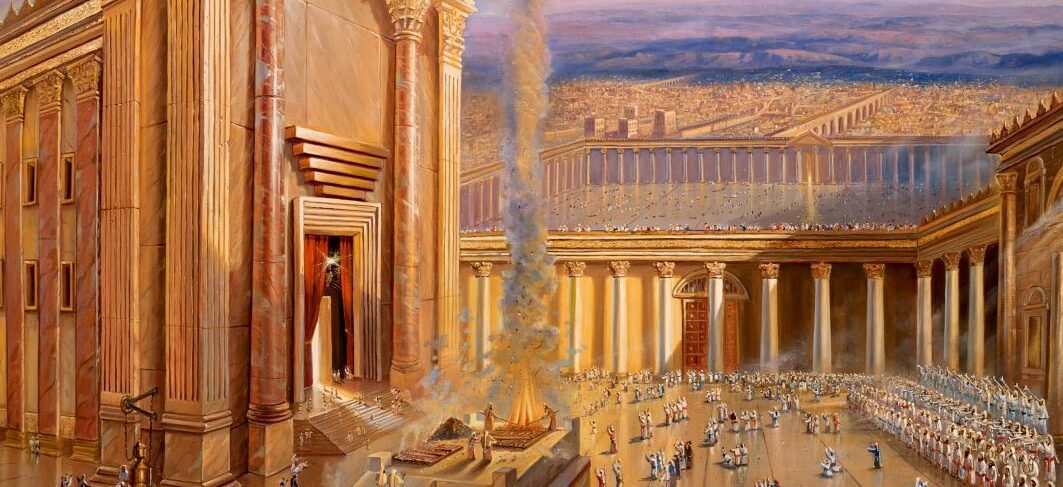
The rebuilding of the Temple was not a smooth process. The altar was rebuilt and sacrifices were restored fairly quickly (Ezra 3:1-6, about 537 B.C.) The foundation of the Temple itself was laid, to mixed reactions. There was rejoicing at the prospect of having a Temple again. However, there was also grief by those who remembered the original; the replacement was smaller and inferior in their estimation (Ezra 3:10-13, Haggai 2:3).
Then came opposition from the neighbors. Some non-Israelites, imported to the area during the Assyrian conquest in 722 B.C., wanted to join in the Temple-rebuilding project. When they were denied, they began actively opposing and harassing the project. They succeeded in delaying it significantly. The prophets Haggai and Zechariah urged that work be continued. Ultimately, King Darius found the original decree from Cyrus and not only allowed but actively facilitated the work (Ezra 4:1-6, 4:24, 5 and 6:1-12).
Note that Ezra 4:7-23 is a parenthetical note referring to later events. Its interaction with King Artaxerxes concerned the rebuilding of the city walls during the time of Ezra and Nehemiah, rather than the rebuilding of the Temple. Its placement here indicates an ongoing pattern of opposition during the entire return from exile.
The first six chapters of Ezra are historical to Ezra himself. His own ministry starts a few decades later in chapter 7, under King Artaxerxes in 440 B.C. Ezra was contemporary with Nehemiah in 430 B.C., whom Artaxerxes allowed to return to Jerusalem to rebuild the city walls.
The new Temple was finally completed in 516 B.C. That was twenty years after it was begun, seventy years after the destruction of the original, and exactly as Jeremiah predicted and Daniel prayed.
And the elders of the Jews were successful in building through the prophesying of Haggai the prophet and Zechariah the son of Iddo. And they finished building according to the command of the God of Israel and the decree of Cyrus, Darius, and Artaxerxes king of Persia. This temple was completed on the third day of the month Adar; it was the sixth year of the reign of King Darius.
Ezra 6:14-16
And the sons of Israel, the priests, the Levites and the rest of the exiles, celebrated the dedication of this house of God with joy.
Scholars note a significant point that did NOT happen: As opposed to the two earlier dedication ceremonies, Ezra makes no mention of the cloud of God’s glory filling the new Temple. However, to the people, their focal point to worship their God had been restored to them.
God’s glory did not enter the Second Temple until Jesus did:
And when the days for their purification according to the law of Moses were completed, they brought Him [the baby Jesus] up to Jerusalem to present Him to the Lord.
…
And there was a man in Jerusalem whose name was Simeon; and this man was righteous and devout, looking for the consolation of Israel; and the Holy Spirit was upon him. And it had been revealed to him by the Holy Spirit that he would not see death before he had seen the Lord’s Christ. And he came in the Spirit into the temple; and when the parents brought in the child Jesus, to carry out for Him the custom of the Law, then he took Him into his arms, and blessed God, and said,“Now Lord, You are releasing Your bond-servant to depart in peace, according to Your word; for my eyes have seen Your salvation, which You have prepared in the presence of all peoples, A LIGHT OF REVELATION TO THE GENTILES, and the glory of Your people Israel.”
Luke 2:21-32
Herod the Great (the one of Jesus’ birth, not His later ministry) made massive additions to this second Temple. He doubled the size of the complex, adding courtyards, colonnades and porticoes while also enlarging the main building. This required the building of massive retaining walls, as well. Herod’s Temple is the one Jesus and His followers visited. It is also the one destroyed by the Romans in 70 A.D. (as Jesus had predicted, Matthew 24:1-2). The western retaining wall, the “Wailing Wall”, is the only portion still available today.
The New Temple: Us
There is no longer a building that is home to the display of God’s glory. But that glory is still displayed, and it still has a home. That home is within each Christian.
Or do you not know that your body is a temple of the Holy Spirit who is in you, whom you have from God, and that you are not your own? For you have been bought with a price: therefore glorify God in your body.
1 Corinthians 6:19-20
The Tabernacle, Solomon’s Temple, and the Second Temple were all built for the purpose of honoring God. He showed His acceptance of those Temples by choosing to make His presence noticeable in them. As the people strayed from that purpose, the Temples were diminished or destroyed.
For Christians who have chosen to accept Jesus as our Savior, we now act as His Temples. His Spirit lives within us, and our purpose is to honor Him. May we not stray from that purpose and allow the glory of His presence to be diminished in our lives!