
In a previous article discussing the formal statements of faith — the creeds, confessions, and catechisms — made by Christians throughout the centuries, I skimmed past the question “Don’t all Christians believe the same thing? Why are there separate denominations of churches within Christianity?” My short answer at the time was:
Christians are humans, and therefore approach even faith from their individual perspectives. However, we have much more in common than otherwise. If you compare these documents [the creeds, etc], they will seem quite repetitive. We all answer ultimately to the same Bible, to the God it reveals, and to the Christ it presents as our Savior. There is plenty of room for grace when we differ on some details while agreeing on all major points.
I’d like to use this article to explore more about those different denominations, and what difference they make to our understanding of Christianity as a whole.
How many denominations are there?
It’s often said that there are thousands of Christian denominations. Quotes regularly go as high as 45,000 or more. Are we really that divided?
No, we aren’t. The high numbers come from a respectable source, the World Christian Encyclopedia and the related World Christian Database. However, most who quote that source overlook a key definition it uses for the term “denomination”. For their statistics, information is grouped by country. If the same faith group, such as Roman Catholic, is active in multiple countries, that gets counted as multiple denominations. As the Encyclopedia says in its section on Methodology (my emphasis):
[A denomination is defined as] an organised Christian church or tradition or religious group or community of people or aggregate of worship centre or congregations, usually within a specific country, whose component congregations and members are called by the same name in different areas, regarding themselves as an autonomous Christian church distinct from other churches and traditions.
Page 905
…
For example, the presence of the Catholic Church in the world’s 234 countries results in 234 Catholic “denominations”…
Here is a video that goes into more detail on the World Christian Encyclopedia/Database, its history, and its intended use vs. misuse.
That same source starts with broader definitions before drilling down to denominations. They separate three major “traditions”: Catholic, Orthodox, and Protestant (plus a fourth: Independent). Within these are what the researchers call “families”. The Catholic tradition has Roman and Byzantine families, for instance. Orthodox has Eastern and Oriental; Protestants and Independents have Anglicans, Baptists, Lutherans, Methodists, Presbyterians, etc. That is more the level that I usually think of when talking about denominations.
Why not just one big church, with no divisions?
The New Testament church didn’t have denominations. It was originally based in Jerusalem, was still very Jewish in background, and was led directly by the Apostles, Jesus’ original disciples. That quickly grew as missionaries such as Paul established churches throughout the Roman empire, many with non-Jewish backgrounds. Beyond Rome, the gospel was spread to places like India, Persia, and even China within a few centuries.
Those original twelve disciples could, from personal experience, teach what Jesus did and describe what it was like to follow Him. Obviously, though, they couldn’t long remain the only leaders or voices of authority as the number of believers increased dramatically. How were Jesus’ followers to go about their commission to “Go therefore and make disciples of all the nations, baptizing them in the name of the Father and the Son and the Holy Spirit, teaching them to observe all that I commanded you“? (Matthew 28:19-20) How were future generations around the world to know how to correctly follow Him?
Some organization was needed. Local congregations needed leadership. The fundamentals of the faith had to be preserved as the church grew. Those needs were met by:
- The Holy Spirit within each believer, guiding them one at a time in their new life (John 14:26)
- Scripture, which includes both the existing Jewish scripture that we now call the Old Testament, and also the New Testament written by the Apostles (and their associates) who were closest to Jesus during His ministry (2 Timothy 3:16-17, Luke 1:1-4, Acts 1:1-8)
- Leaders of local congregations, some appointed by the Apostles and some acknowledged for their Spirit-led gifts (Romans 12:6-8, 1 Timothy 3)
However, thousands — now millions — of people of varied backgrounds, cultures, locations, and languages don’t share a “hive mind”. We aren’t clones or Star Trek “Borg” creatures. As individual Christians have found themselves drawn to one leadership style or another, or to varying approaches to worship, or to different shades of meaning and interpretation of important Scriptures, they have coalesced into groups of like-minded fellow believers. This diversity is fine, as long as we all are unified around the same core: Christ.
How did separate denominations get started?
Once Christianity became the official religion of the Roman Empire (due to the conversion of Emperor Constantine in about 312 A.D.) the direction of the little-c “catholic” (universal) church became entwined with Roman politics. The bishop of the church in Rome was considered the leader over the entire church as a whole. When the empire split into Eastern (Byzantine) and Western empires, the church followed suit, resulting in what are now the Catholic and Orthodox traditions.
Over a thousand years later, the (Roman) Catholic hierarchy had become quite corrupt. For instance, they sold “indulgences”, promising less punishment for sin…in return for a small fee paid to the church. This kind of distortion of the Gospel prompted Martin Luther to launch the Protestant Reformation in 1517. Its foundation was in five “solas” (meaning “sole” or “only”):
- sola scriptura (Scripture alone): The Bible is the only written authority considered infallible.
- solus Christus (Christ alone): Salvation is possible through Christ alone, not ourselves or any other human being.
- sola fide (faith alone): Salvation is received by faith, not through any action or work that we do.
- sola gratia (grace alone): Salvation is offered as unconditional grace given by God as His choice, not ours.
- soli Deo gloria (glory to God alone): No one else gets any credit for salvation, except God.
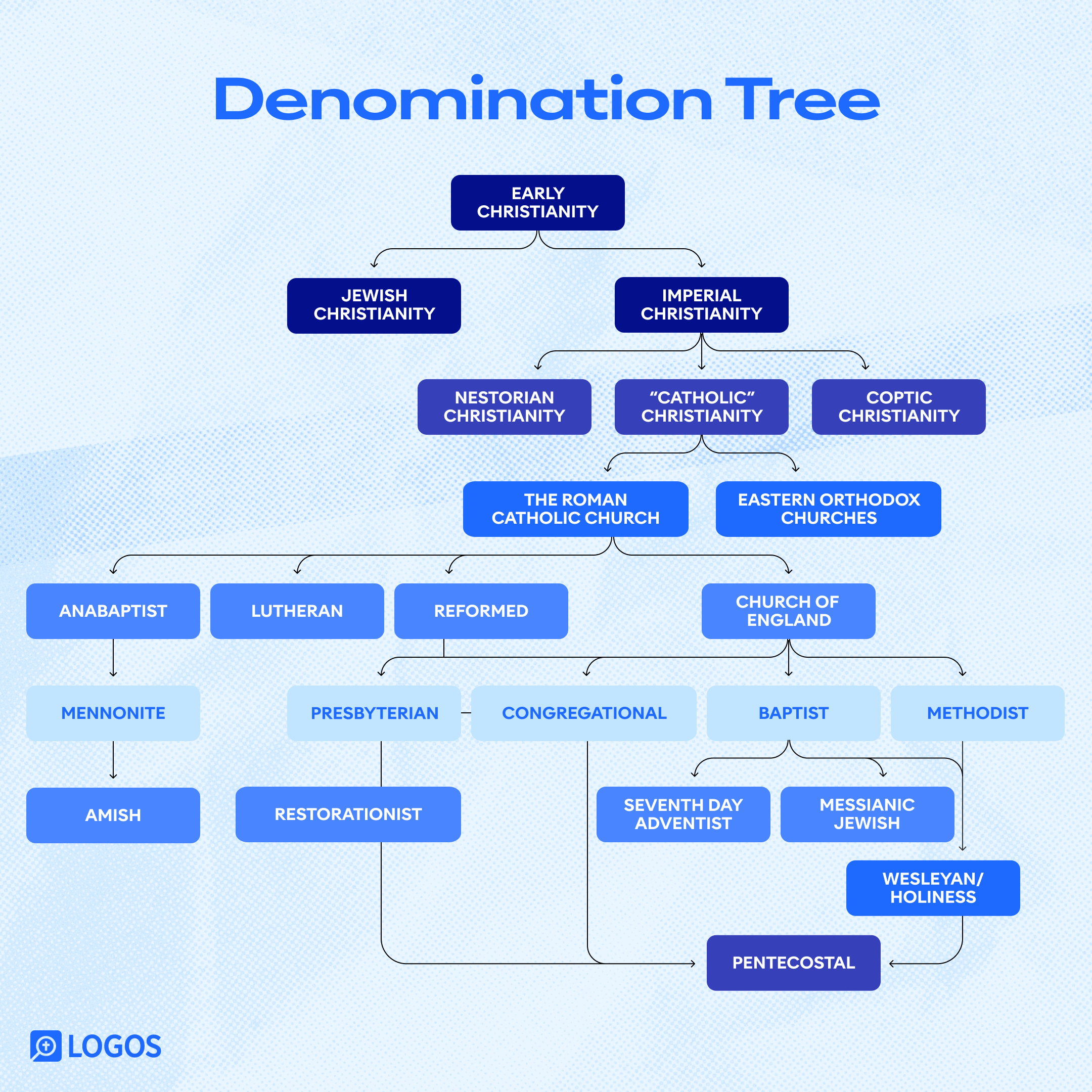
After the Reformation, the Church of England (Anglican or Episcopal) remained roughly aligned with the Roman Catholic church. Within Protestantism, there was a segment (Lutheran) that remained closely associated with Martin Luther. Another broad segment, simply named “Reformed” and led by John Calvin among others, differed with the Lutherans especially over how Christ is embodied in the Lord’s Supper/Communion/Eucharist, the ritual remembrance of His sacrifice.
A sub-group with the Church of England, the Puritans, were concerned with how tightly that church was associated with the monarchy. They wanted further reform that would distance the church from politics. Being persecuted in England, they moved to the new colonies in North America. From Puritans grew denominations such as Presbyterian, Baptist, Congregationalist, and Quaker. Another sub-group within the Church of England was the Methodists, first led by John Wesley, who emphasized more individuality as opposed to the more rigid formal worship style.
Here is a “family tree” of denominations as presented by the folks at Logos Bible software:
What are the differences between denominations?
With so many denominations interrelated in one big family, it is difficult to concisely list all the distinctions. Many of the differences are in organizational style (“Who’s the boss?”) or worship style (Preset words, songs, prayers, and sequence vs. more free-flowing). Some are based on doctrine and Biblical interpretation, such as sacraments like baptism and Eucharist (Lord’s Supper/Communion). Here is a very limited and over-simplified attempt at a quick summary.
Roman Catholic: Church tradition is authoritative, in addition to the Bible; The Pope is the human head of the Church and speaks with divine authority; Salvation provided by Christ but received via sacraments such as Eucharist (among others); Mary and saints honored and receive prayers.
Anglican/Episcopal: Similar to Roman Catholic, with emphasis on formal liturgy, sacraments, and respect for church tradition; led by a hierarchy of bishops leading up to arch-bishops.
Baptist: Emphasis on the autonomy of the local church and of individual believers, no hierarchy enforced; baptism only for believers as demonstration of (not means of) salvation; baptism by full immersion, not by sprinkling.
Congregationalist/Church of Christ: Autonomy in local churches; baptism by immersion required for salvation; simplicity in worship (no musical instruments, for instance).
Eastern Orthodox: Much in common with Roman Catholic, but led by teams (“synods”) of bishops rather than by a single Pope.
Lutheran: Doctrine based on Martin Luther’s theology.
Methodist: Closely aligned with Arminian theology.
Presbyterian: Churches led by teams of elders. Doctrine based on Calvinism.
Most importantly, what do all denominations have in common?
In a word: CHRIST!!!
Within the wide variety of specific leadership and worship styles, doctrinal and interpretation differences, and balance of emphases on one point or another, to be a Christian is to depend on Christ as the only way that sinful human beings are reconciled with the holy God against Whom they have rebelled. All differences fade in significance when compared to Him.
During His last time with His disciples before His crucifixion, Jesus prayed for their unity.
I do not ask on behalf of these alone, but for those also who believe in Me through their word; that they may all be one; even as You, Father, are in Me and I in You, that they also may be in Us, so that the world may believe that You sent Me.
John 17:20-21
We may be convinced that a specific point is right, and that denominations who disagree with that point are wrong. But just as God gives us the grace to make our own choices, we must extend that same grace to others. We’ll learn the perfect answers when we all get to Heaven 1, carried there by Him.
There’s an old joke about a newcomer being guided around Heaven. As they are led down a long hallway with many rooms, one for each denomination, they are warned to be quiet when passing a specific one. “Shhhh! That’s the [insert denomination to be teased] room. Don’t let them hear you. They think they are the only ones here!” 😁
Whenever this becomes more reality than teasing, that is a good sign that God is not finished with us yet!
Note: For more on the origin and specific details of different denominations, here are some of the references I used: The Gospel Coalition, Logos, Theology Pathfinder. The links embedded above also provide additional information.